Meet the Faculty: Jack Snowdon
Brewster Communications
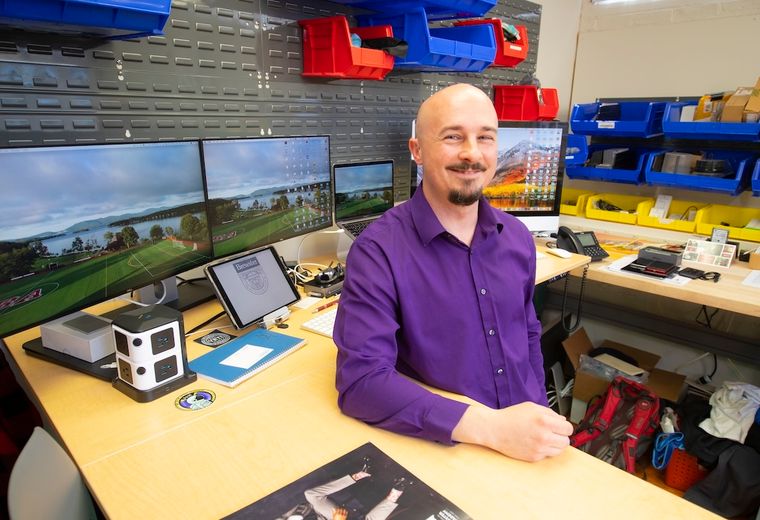
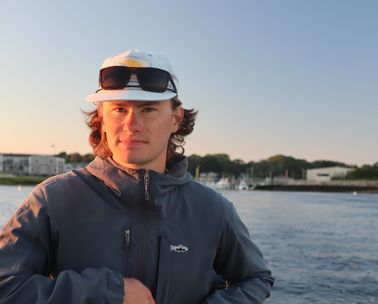
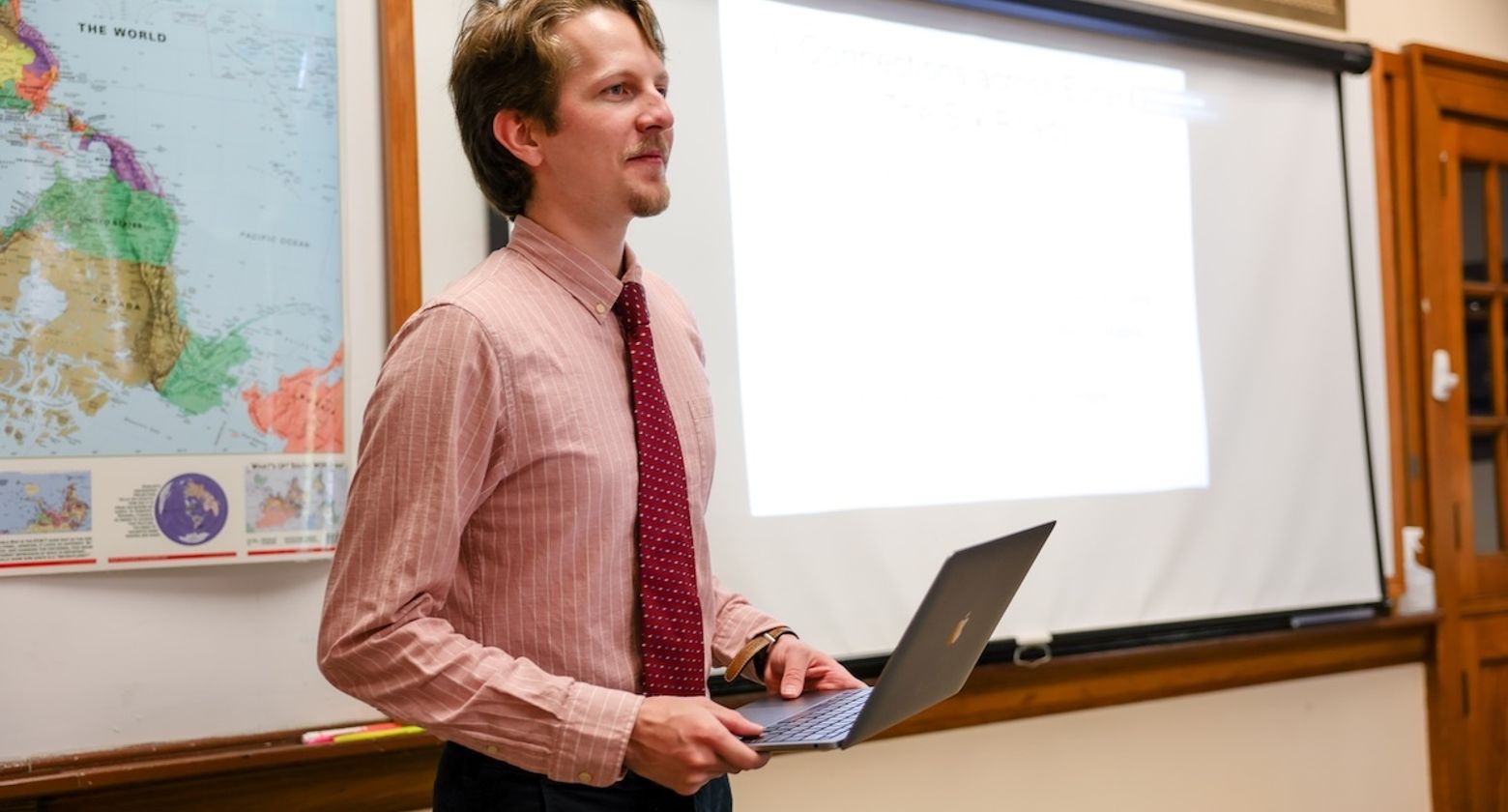
With a global perspective shaped by a childhood spent moving between states and countries, Brewster history teacher Jack Snowdon brings a deep passion for human stories and the different cultures that shape them. A lifelong hockey player and avid writer, Mr. Snowdon joined Brewster in 2022 and is motivated by making a positive impact on students both in and out of the classroom.
When he’s not teaching or coaching, Mr. Snowdon enjoys writing, ice skating, recreational sports, video games, and reading—and he’s quickly found favorite Wolfeboro routines like grabbing a coffee in town and attending open mic nights in the Rogers. We sat down with him for a Q&A to learn more about his path, his philosophy, and what he loves most about the Brewster community.
Q: You grew up moving between states and countries. Can you share more about that journey and how it shaped you?
A: I think that moving frequently in my childhood was a major factor in the development of who I am today. My father worked for NCIS, which is a civilian position, but it led to many of the same characteristics that might be familiar to an Air Force or Navy brat; he always worked on a Navy base, and our moves were based on that. I was born in Virginia Beach, but within a few months we had moved to Iceland, followed by Japan, Washington state, back to Virginia, Florida, California, Virginia for a third time, and finally here in New Hampshire. I feel fortunate to have been able to experience different cultures and meet people I otherwise would not have had the chance to, and I think that is at least one factor that drew me toward studying world history.
Q: What first pulled you toward history as a discipline? Was there a class, teacher, book, or moment when it really “clicked” for you?
A: Beyond my upbringing, where I already had a healthy respect for history, it wasn’t until tenth grade that it really clicked for me. It was a combination of my excellent AP World History teacher and the computer game Sid Meier’s Civilization V that led me to realize that all of these terms, concepts, and figures were once the real lives of real people. In my view, there are many practical and applicable lessons to be drawn from studying history, but the most important is a broader sense of empathy and an understanding of our shared humanity.
Q: In your Brewster bio, you mention that you are motivated by making a positive impact in the community, both in and out of the classroom. What does “impact” look like to you on a good day at Brewster?
A: As a teacher, some of my best memories thus far have been when students stay after class to continue to discuss the material and go beyond the information covered in the lesson. It shows me that what we’re learning matters to them. But I’m also hopeful that some of the impacts might take form in ways that I won’t see; that at some point in the future, they may face an assignment or a task that they will be better prepared for because of something they did in this class or some skill they developed, whether they know it or not. Or maybe they’ll see a news article and connect it to a topic we talked about. That’s my hope, in any case.
Q: What is your favorite historical period or theme to teach? Why does that particular topic excite you as a teacher?
A: I particularly enjoy teaching about revolutions. In Topics in Global History, my module focuses on the revolutions in France, Haiti, Russia, and China. I find it fascinating to explore the tension between high-minded ideals that can drive change and the practical challenge of human ambition. Each of these revolutions offers examples of people who seem to devote their lives to improving conditions for those around them before, in the eyes of many contemporaries, betraying their word in some way. It makes for really fascinating and deeply human stories.
Q: I came across a story about an oral history project you volunteered for at Christopher Newport University. Can you tell us a bit about that experience, and how it has influenced the way you teach now?
A: Thank you for the trip down memory lane with this question! What really struck me about that project was that, while I had always looked for personal stories and interactions, my area of interest had typically been world history, where even primary sources are usually read and studied in books. For that project, in the case of my interview with Dr. Pearson, I was hearing a personal, intimate recollection of lived history without any scholarly sanitization. With my students, I try to highlight individual stories in my instruction, along with a handful of assignments that support them in making historical, human connections on their own, such as writing a historical fiction short story set in the time period being discussed in class.
Q: What is one historical misconception you love to disrupt–especially something students often assume is simple but that turns out to be much more complicated?
A: A student once told me that we are smarter than people used to be, and when I asked why, they said, “Because we have air conditioners.” In their defense, they were looking around the room for an example of modern technology, and that was what came to mind. But are you and I really smarter than our ancestors just because we live after the air conditioner was invented? There are undoubtedly many aspects of the modern age that we should be thankful for and celebrate, but I always try to remind my students that people who lived in the past were much more clever than we usually give them credit for. Even where they were decidedly unclever, they still had real thoughts and real lives that go beyond the fanatical, superstitious, brutish caricatures we sometimes form of them.
Q: You recently traveled to Washington, D.C., for the National Council for the Social Studies conference. What is one takeaway that you brought right back into your teaching?
A: The NCSS conference in D.C. was a great experience, and I felt fortunate to have the opportunity to attend. The first keynote speaker, Jeffrey Rosen, made some really interesting comments about how the temptation to choose the path of least resistance is a struggle even for him, with a phone always close at hand. He highlighted the benefits—citing various Founding Fathers along the way—of taking time to engage with challenging texts and new ideas. It really made me think about how I can foster that kind of learning in the classroom. There was also a speaker who focused on using political cartoons in lessons on certain topics, a strategy I look forward to applying later this year.
Q: While you were in Washington, D.C., did you have a chance to play tourist or visit any museums? What did you enjoy the most?
A: On our final day in D.C., we had a chance to visit some spots around the city. The Holocaust Memorial Museum was a powerful experience; I was particularly struck by the focus on ordinary individuals who both enabled and resisted the atrocity, and by the line “What You Do Matters,” which appears prominently at the end and has stayed with me.
Q: We know you like to write. Would you like to share anything about the kind of writing you do?
A: Nothing particularly noteworthy, but it’s been a hobby of mine since my freshman year of college. My gratitude to Dr. Nigel Sellars for getting me started!
Q: Okay, a few rapid-fire questions. What is your favorite way to spend a winter afternoon in Wolfeboro?
A: Grabbing a coffee at a cafe.
Q: Favorite video game?
A: Super Smash Bros. Ultimate
Q: What is one Brewster moment (so far) that made you think, “Yep—this is why I’m here”?
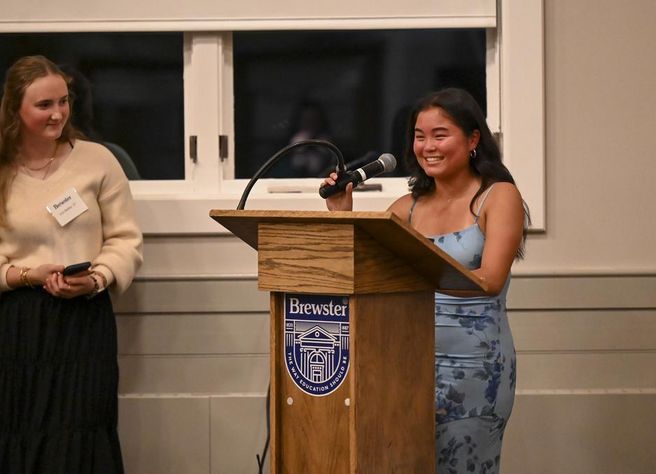
A: Attending open mic night in the Rogers